
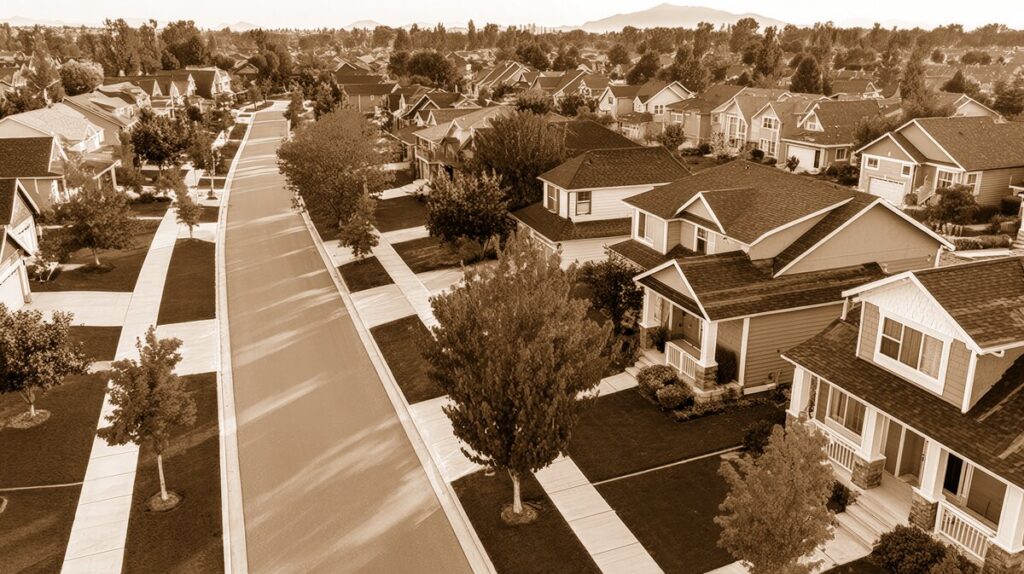
A Neighborhood on Lynchburg’s Edge
Sunburst Hills is one of those Lynchburg-area neighborhoods that feels familiar even to people who have never lived there. Tucked in the rolling countryside east of the city, near Evington and the Waterlick Road corridor, it reflects a later chapter in the region’s residential history—one shaped less by grand Victorian houses or streetcar lines and more by spacious lots, winding roads, and the appeal of living close to Lynchburg without being in the middle of town.
The neighborhood is associated primarily with Sunburst Hills Road, which appears in Campbell County’s official street records as a road connected with the greater Lynchburg area. Addresses along Sunburst Hills Road use Evington, Virginia, even though the community is often described locally as part of the Lynchburg area. ([co.campbell.va.us](https://www.co.campbell.va.us/DocumentCenter/View/13199/Campbell-County-Street-Name-Database-?utm_source=openai))
That distinction is part of the neighborhood’s character. Sunburst Hills belongs to the broader community surrounding Lynchburg: close enough for work, school, shopping, churches, and medical care, but removed enough to retain a quieter, more rural atmosphere.
Where the Name Comes From
Unlike Lynchburg’s older neighborhoods—such as Garland Hill, Diamond Hill, or Federal Hill—Sunburst Hills does not appear to have been named for a prominent nineteenth-century family or civic leader. Its name is more descriptive and modern.
The phrase “Sunburst Hills” evokes the neighborhood’s setting: open, elevated ground, broad views, and sunlight breaking across the surrounding hills. The name likely reflects the visual appeal that attracted residents when the area began developing as a suburban and semi-rural residential community. While publicly available county records confirm the road and neighborhood name, they do not document a single official naming story or founding dedication. The most responsible way to understand the name is as a marketing and landscape description—one that captures the light, elevation, and spaciousness of the area.
That simplicity suits Sunburst Hills. It is not a neighborhood built around a courthouse, industrial mill, college campus, or historic commercial street. Its identity comes from the land itself and from the everyday life of the people who settled there.
Origins in the Suburban Era
Sunburst Hills belongs largely to the period when Lynchburg-area development began moving beyond the city’s historic hills and established urban neighborhoods. Lynchburg’s older residential districts grew outward from the James River and downtown during the nineteenth century, while twentieth-century transportation improvements made it increasingly practical for families to live farther from the center of the city.
By the second half of the twentieth century, roads such as Waterlick Road and nearby routes through Campbell County connected rural communities with Lynchburg’s employment centers and services. Larger homes, private driveways, and generous wooded parcels became attractive to residents who wanted more room than a traditional city lot could provide.
Real-estate records and local property listings generally associate homes in Sunburst Hills with the 1970s and 1980s, suggesting that the neighborhood’s principal growth occurred during that suburban expansion. One local account describes the area as an older neighborhood with solid homes dating mostly from those decades, along with wide streets and active family life. ([trulia.com](https://www.trulia.com/home/0-sunburst-rd-66-evington-va-24550-439939833?utm_source=openai))
Those homes tell an important story. Rather than following one highly uniform architectural plan, the neighborhood developed with the variety typical of its era: split-levels, ranch houses, two-story residences, brick exteriors, wood siding, attached garages, and houses set back among mature trees.
A Community of Roads and Residences
The heart of Sunburst Hills is residential rather than commercial. Sunburst Hills Road serves as the neighborhood’s best-known address, while Sunburst Road and nearby county routes help connect the community to Waterlick Road, Timberlake, Evington, and Lynchburg proper.
For longtime residents, the neighborhood’s roads are more than lines on a map. They are where children learned to ride bicycles, neighbors exchanged greetings, and families took evening walks. The absence of dense commercial development has helped preserve the feeling of a place where home life remains the central focus.
The neighborhood’s layout also reflects the terrain. Instead of a rigid urban grid, roads follow the contours of the land, creating a sequence of gentle rises, curves, and wooded stretches. In a city famous for its hills, Sunburst Hills offers a quieter, more spacious version of the same topographical experience.
The Greens and Community Life
A notable feature associated with Sunburst Hills is The Greens, a community area maintained through the Sunburst Hills Property Owners Association. The association’s work reflects a common thread in established suburban neighborhoods: as homes age, residents increasingly become stewards of shared spaces, entrances, landscaping, roadsides, and neighborhood appearance. ([shpoa.com](https://shpoa.com/menu.html?utm_source=openai))
That kind of stewardship is easy to overlook, but it is often what allows a neighborhood to mature gracefully. In Sunburst Hills, the goal has not been to freeze the community in one period. Instead, homeowners have updated kitchens, roofs, porches, landscaping, and interiors while retaining the spacious layout and familiar appearance that give the neighborhood its identity.
Community life also extends beyond the subdivision itself. Residents have long been connected to churches, schools, shopping areas, and civic organizations in Evington, Timberlake, and Lynchburg. Nearby roads lead toward Liberty University, Lynchburg Regional Airport, Centra Lynchburg General Hospital, and the commercial centers along Wards Road and Timberlake Road. The neighborhood’s location makes it possible to enjoy both country quiet and city convenience.
A Mid-1980s Milestone
One documented milestone in the neighborhood’s story came in 1984, when Gladysbrook Properties, Inc. formed a partnership called Sunburst Hills Apartments. The development reflects the broader evolution of the area from a collection of individual homes into a more established residential community with multiple housing types. ([summitlynchburg.org](https://summitlynchburg.org/community-life/senior-care-community-lynchburg-va/?utm_source=openai))
The presence of apartments added another layer to the neighborhood’s history. Like many Lynchburg-area communities, Sunburst Hills became home not only to families purchasing houses but also to renters, older adults, young professionals, and residents who valued the location without wanting to maintain a large property.
Over time, the community has continued to change through ordinary but meaningful transitions: children growing up and moving away, new families arriving, longtime owners renovating older homes, and property passing from one generation to the next.
What Sunburst Hills Preserves
Sunburst Hills is not preserved through a formal historic-district designation. Lynchburg’s locally designated historic areas include neighborhoods such as Court House Hill, Daniel’s Hill, Diamond Hill, Garland Hill, Federal Hill, Pierce Street Renaissance, Rivermont, and the Virginia University of Lynchburg campus; Sunburst Hills is not among those districts. ([lynchburgva.gov](https://www.lynchburgva.gov/295/Local-Districts-Sites?utm_source=openai))
Its heritage is therefore more personal and environmental than architectural. The neighborhood preserves the memory of a time when families sought land, privacy, and a slower pace while remaining connected to a growing city.
That heritage can be seen in mature trees, older brick homes, long driveways, and the familiar rhythm of a residential road. It can be heard in stories about neighbors helping one another, children playing outdoors, and residents watching the community change without losing its essential character.
Sunburst Hills Today
Today, Sunburst Hills remains a comfortable example of Lynchburg-area suburban living. Its homes have aged, but many have also gained character. The trees are taller than they were when the first houses were built. Gardens have filled in. Driveways and porches show the personal touches of several generations of homeowners.
What makes the neighborhood special is not one spectacular landmark. It is the cumulative effect of ordinary places: Sunburst Hills Road at sunset, a familiar house at the bend, a well-kept common area, and the sense that people have chosen to stay.
Sunburst Hills reminds us that local history is not found only in courthouses, churches, museums, or nationally recognized landmarks. Sometimes it lives in a neighborhood created during the suburban decades, shaped by a beautiful name, and sustained by the residents who continue to call its hills home.